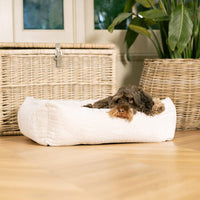
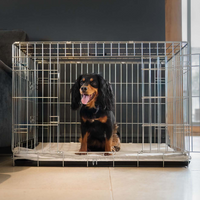
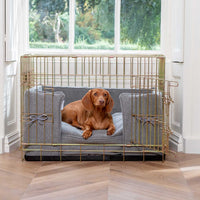
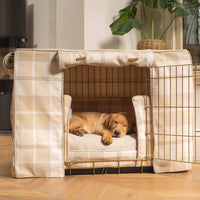
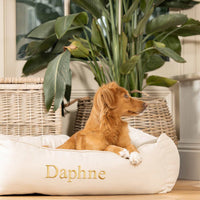
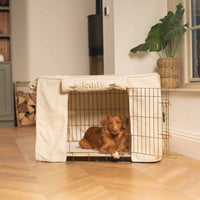
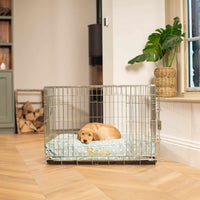
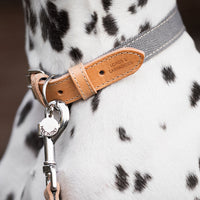
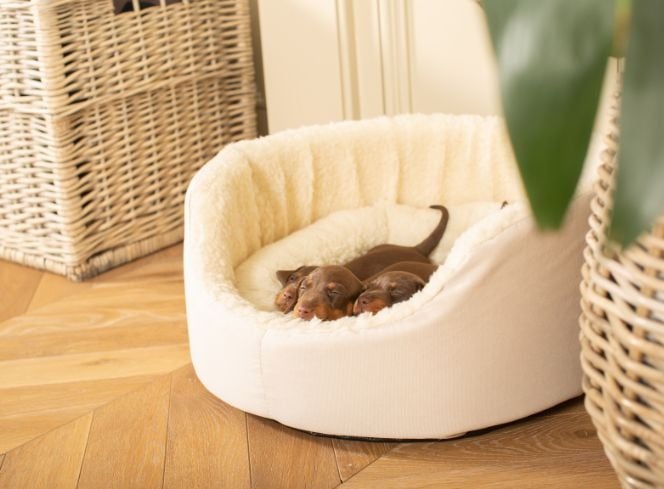
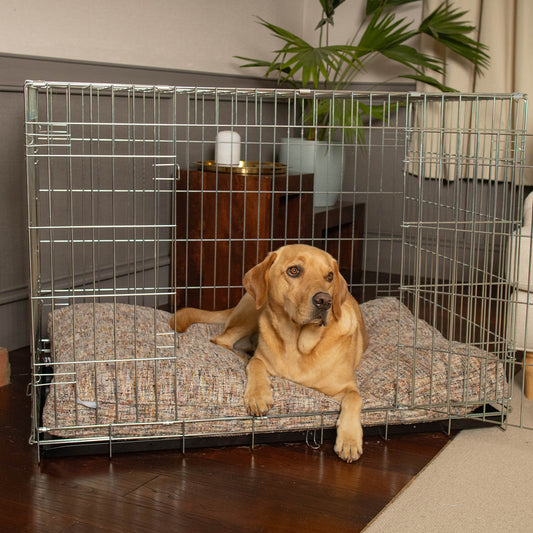
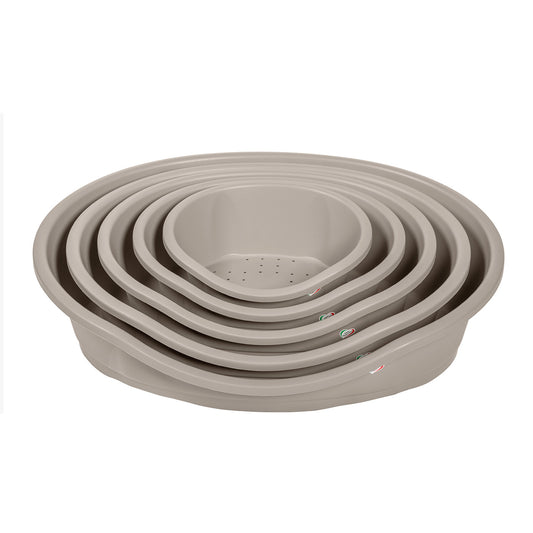
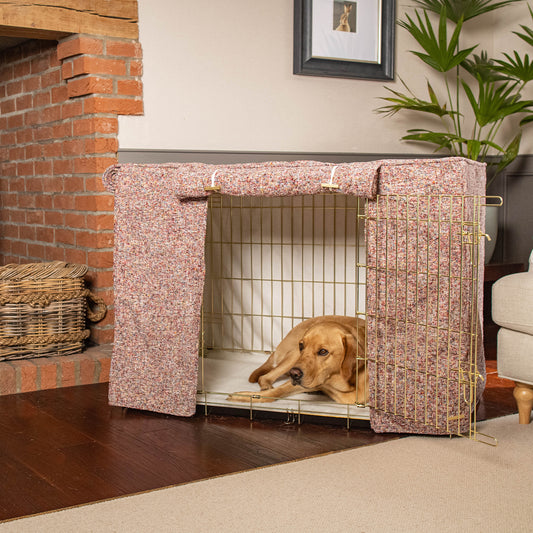
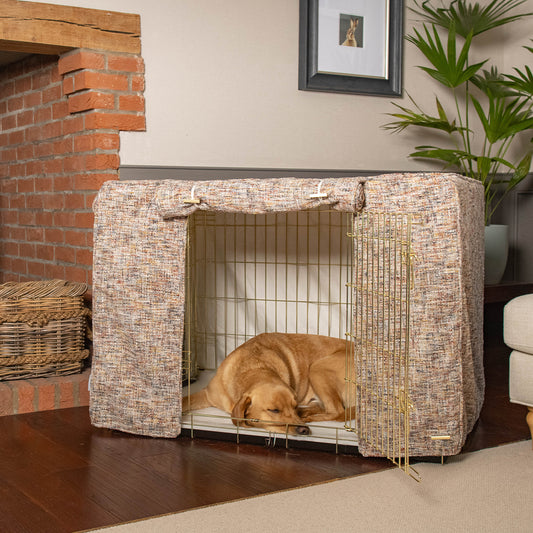
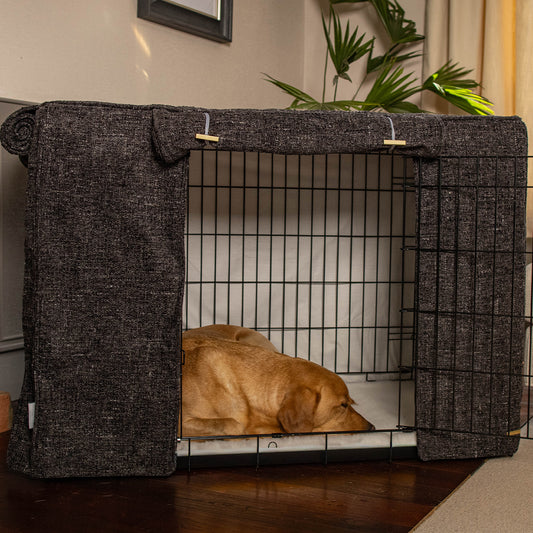
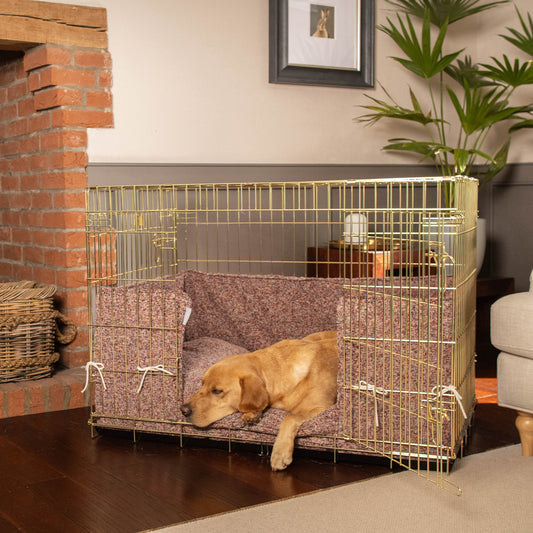
Did you know dogs spend 12 to 14 hours a day sleeping? That's a lot of time in bed so it's no surprise that their bed might be looking a little worse for wear. Dogs are creatures of comfort so making sure they have a a clean and supportive bed is essential for their overall well-being. In this guide, our Pet Experts explore the signs that indicate it's time to change your dog's bed and share expert tips on how to care for your canine's cherished sleeping spot.
How Often Should You Replace Your Dog’s Bed?
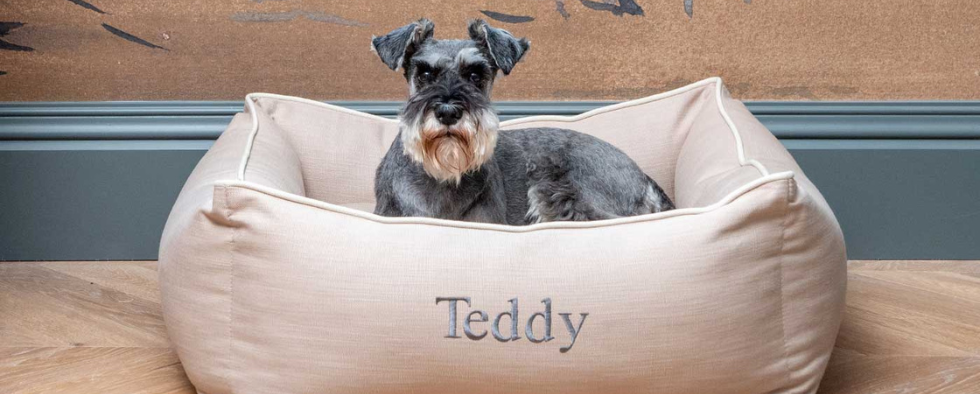
Determining how often to replace your dog's bed depends on several factors including the quality of the bed, your dog's size and activity level, and any specific health considerations. As a general guideline, it's advisable to replace your dog's bed every 1 to 3 years, or sooner if signs of wear and tear become noticeable.
Signs It's Time to Change Your Dog's Bed:
Visible Wear and Tear: Over time, your dog's bed may start showing signs of wear and tear, such as flattened cushions, lumps, or torn fabric. If you notice any significant damage, it's a clear indication that it's time to consider a replacement.
Lingering Odours: Despite regular cleaning, dog beds can accumulate odours over time, especially if your furry friend enjoys outdoor adventures or has accidents indoors. Lingering smells that persist even after washing could signal the need for a new bed.
Loss of Support: Just like humans, dogs require proper support for their joints and muscles, especially as they age or if they have existing health conditions. If your dog's bed no longer provides adequate support or has become too soft, it's time to invest in a new one to ensure their comfort and well-being. It might be worth investing in an orthopaedic dog bed if your dog’s breed is prone to joint issues.
Allergies and Skin Irritations: Dogs can develop allergies or skin irritations from prolonged exposure to dust mites, pet dander, or other allergens that accumulate in their beds over time. If you notice your dog scratching more than usual or experiencing skin issues, a new bed with hypoallergenic materials may offer relief.
Preference for Alternative Sleeping Spots: Dogs are creatures of habit, and if you notice your furry friend opting for alternative sleeping spots around the house instead of their bed, it could indicate that they're no longer comfortable or satisfied with their current sleeping arrangements. It’s worth looking at how your dog likes to sleep so you can get the best bed shape to suit their sleeping style, our Information Hub has a guide on how to choose the perfect dog bed for your dog.
Top Ways to Care for Your Dog's Bed:
Regular Washing: Establish a routine for washing your dog's bed to remove dirt, hair, and odour-causing bacteria. Most of our Lords & Labradors dog beds are machine washable, we have a handy guide on how to wash your dog’s bed here.
Use a Removable Cover: Opt for dog beds with removable, machine-washable covers for easy cleaning. Having a spare cover on hand allows you to swap them out while one is being laundered, ensuring your pup always has a fresh and clean place to sleep. We also sell bamboo bed covers which are great for popping over your dog’s bed to help keep them clean especially after a muddy dog walk, they will act as an additional layer of defence against moisture and stains, extending the life of the bed!
Vacuum and Spot Clean: In between washings, use a handheld vacuum or lint roller to remove hair and debris from the surface of the bed. Spot clean any stains or spills promptly to prevent them from setting into the fabric.
Rotate and Fluff: Just like flipping a mattress, periodically rotate your dog's bed to distribute wear evenly and prevent premature sagging. Fluffing the bed's filling helps maintain its loft and support over time.
Sun and Air Dry: On sunny days, take advantage of natural sunlight by airing out your dog's bed outdoors. Sunlight helps eliminate odours and kills bacteria, leaving the bed feeling fresh and revitalised.
Inspect Regularly: Take time to inspect your dog's bed for any signs of damage, loose seams, or worn-out stuffing. Promptly address any issues to prevent further deterioration and ensure your pup's safety and comfort.
By recognising the signs that it's time to change your dog's bed and implementing proper care and maintenance techniques, you can provide your furry friend with a clean, comfortable, and supportive sleeping environment. Remember, a happy and well-rested pup makes for a happier pet parent too!
If you’re looking to upgrade your dog’s bed why not check out our collection of luxury dog beds? Bedding is our speciality, we design and craft all of our bedding here in our Lincolnshire workshop so you can be sure your dog will be getting the best sleep possible in one of our luxury dog beds.
The Importance Of Correct Nutrition For Dogs And Cats!
Ensuring optimal nutrition for our beloved pets is paramount for their overall health and well-being. As responsible pet owners, it is crucial to understand the significance of providing nutritionally complete and balanced meals to our furry friends. In this comprehensive guide, we will delve into the world of dog and cat nutrition, exploring the importance of the right food choices, nutritionally complete homemade recipes, and the best commercial options available.
Understanding Dog and Cat Nutrition
Your pet's nutrition plays a pivotal role in their vitality and longevity. Just like humans, dogs and cats require a balanced diet that fulfils their specific dietary needs. A well-rounded diet supports their immune system, maintains a healthy weight, and promotes optimal organ function. Pet food ranges from being more processed to being raw and rich in natural ingredients, finding the right fit for your pet is important!
Dog Food Nutrition
Choosing the right dog food is a key aspect of canine care. With an abundance of options available, it's essential to prioritise nutritionally complete choices. To make an informed decision, consider using a dog food nutrition calculator and comparing different products. Look for the best nutritional dog food that meets your pet's unique requirements, taking into account factors such as breed, size, and age. Our favourite nutritionally rich dog foods are Orijen, Carnilove and Acana, they are all designed with your dogs nutrition in mind.
Dog Nutrition Facts and Guide
Understanding dog nutrition facts is imperative for providing the best care. Refer to a dog food nutrition guide to navigate through the plethora of choices available in the market. Learn about your dog's daily nutritional requirements and make informed decisions that contribute to their overall health and happiness.
Cat Food Nutrition
Cats, being obligate carnivores, have unique nutritional requirements. The best cat food for nutrition considers their need for high-quality protein and essential nutrients. Explore dry cat food nutrition labels to ensure your feline friend receives a balanced diet that supports their specific dietary needs. For a cat food which is high in protein and great for fussy felines we love Carnilove, they all have at least 80% wild origin meat content and contain No grains, potatoes, GMO, soy, sugar, preservatives or colourants.
Daily Nutritional Requirements for Cats
Cats require a carefully balanced diet to thrive. Knowing the daily nutritional requirements for cats is essential for choosing the right cat food. Consult with your vet to understand the specific needs of your cat, such as the importance of taurine and other essential nutrients crucial for their health.
In conclusion, the importance of correct nutrition for dogs and cats cannot be overstated. Whether choosing commercial options or crafting homemade recipes, prioritising nutritionally complete meals is key to ensuring your pet's health and happiness. Stay informed about dog and cat nutrition, consult with professionals, and make choices that align with your pet's unique requirements. By providing the best nutritional dog food or cat food, you contribute to a longer, healthier life for your furry companions. Here at Lords & Labradors we have a large range of both cat and dog food so you can pick the best option for you and your pet
Crate training is an important part of settling in a new puppy. A crate provides a safe, quiet space for your pup and will help them to get used to their nighttime routine and with toilet training. A dog crate can be made into a cosy den that will be loved by your new four-legged friend for a lifetime. In this article we will explain the best crate set-up for puppies, how to change the set-up as they grow up and also how to look after your crate and crate bedding.
How To Make The Perfect Crate Set-Up For A Puppy
Crate training your puppy will have lots of advantages, helping them to settle and feel safe in their home as well getting them into a consistent bedtime routine. The perfect crate for a puppy will feel safe, warm and cosy. It’s important that it’s inviting so that they feel compelled to use it.
With this in mind we’d suggest the following items:
Crate Cover
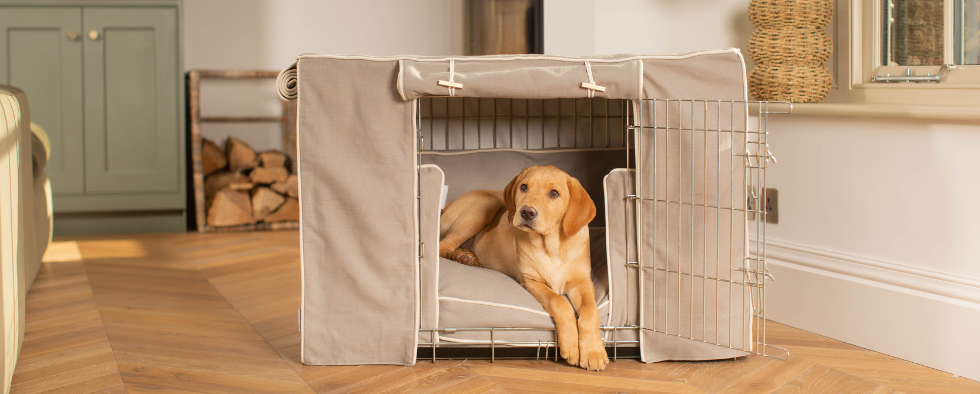
[product]Crates in their basic form can be rather draughty and a little bit unsightly! A crate cover will not only make the crate look stylish, but it will make the crate feel cosy inside. Our crate covers feature roll down doors which can be lowered when it’s time for bed. Puppy will soon learn when they should be sleeping (doors rolled down) and when it’s time to get up (doors rolled up). Our crate covers come in a range of fabrics which have been designed to match your home and they're all machine washable, making them brilliant for puppies!
Cosy & Calming Puppy Crate Bed
[product]
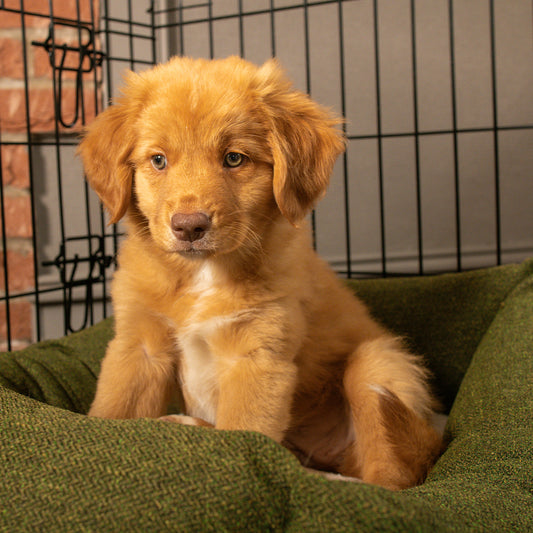
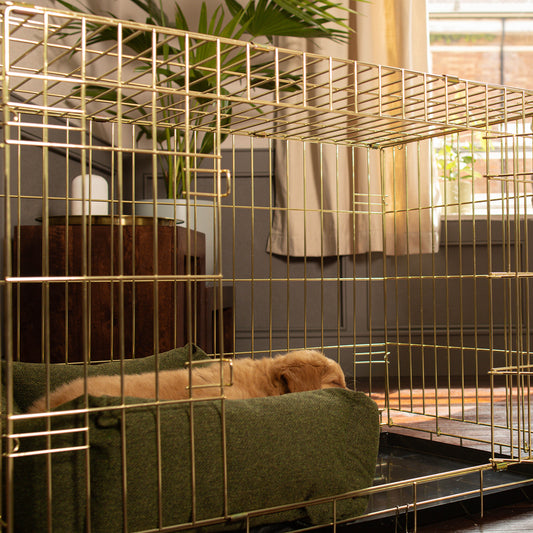
Our cosy and calming beds have been designed with crate training in mind. Each size is made to fill exactly one half of the corresponding crate size. So if you have a small crate for a Chihuahua for example, the small bed will fit in exactly one half of the crate. This then leaves room for a puppy pad in the other half along with a bowl for water. They come in a range of our printed cotton fabrics and feature a reversible cushion pad inside - one side covered in super plush sherpa!
Puppy Pads
Whilst we don’t want to encourage puppies to pee in the crate, it’s also important to note that they can’t hold themselves for very long at all. Whilst you will be able to take them outside at regular intervals during the day, this may not be the case at night. When you put them to bed, putting a puppy pad in one half of the crate will help to stop any accidents from dirtying their bed or crate tray.
Crate Bowls
Puppies will need access to water at all times and a crate bowl is a brilliant accessory as it can be fastened to the crate walls. This will ensure it doesn’t get tipped over or knocked like a standard bowl might.
The Perfect Crate Set-Up For An Adult Dog
As your dog becomes toilet trained and they begin to need the full space of the crate for their bed, you will need to consider swapping out the puppy accessories for their proper adult bed. At Lords & Labradors we specialise in crate bedding that will make your dog’s den look stunning as well as super comfortable inside.
Crate Cushion
Our crate cushions are designed to fit our crates perfectly. They come in a range of fabulous fabric designs from luxurious tweeds to printed cottons. There really is something to suit every taste and home.
Crate Bumper
Crate walls aren’t the most comfortable things to snuggle up to, and if your dog likes to curl in the corner of their bed, they will need something other than metal bars! That’s where our fabulous bumpers come in. They sit around the edge of the crate cushion and create a spongey layer of warmth around the walls. Perfect for snuggling up in the corner when nap time calls!
Crate Cover
Our crate covers are perfect for setting a routine with your dog, when the doors are rolled down it will signal to them it's time to sleep. Our crate covers are fully lined to help keep light out and come in matching fabrics to our bumpers and cushions to you can be sure crate will look stylish!
Crate Set Aftercare and How To Clean A Crate
With a little love and care your crate set will last a long time. Here we detail how to look after your crate set:
The Crate - The crate is made of sturdy metal and is really easy to keep clean. Our crates are easy to wipe clean and the tray is removable so you can get into the corners properly. It’s really important to make sure the crate is completely dry before setting back up and allowing your pet back in, we recommend drying your crate to avoid any rusting.
Lords & Labradors Cushion & Bumper Covers - For our bedding from our core collection you will be able to remove the covers on the cushions and bumpers. Turn the cover inside out and machine wash on a 20 degree gentle cycle. Allow the covers to air dry (do not tumble dry). Once dry return the inner cushion to the cover.
Essentials Plush Collection Bumpers & Cushions - Our bumpers and cushions from the Essentials Plush Collection don't have removable covers, we recommend spot washing your essentials plush bumpers and cushions.
Lords & Labradors Crate Covers - Our crate covers are all machine washable on a 20 degree gentle cycle, apart from our oil cloth crate covers. After washing, we recommend air drying your crate cover over your crate to help keep it in shape and to make sure it doesn't shrink. A cool iron on the reverse of the cotton fabrics is fine if necessary, but often they won’t even need that. Our tweeds and Savanna fabrics are super fast drying and they will come out of the spin almost dry. Just give them an air and they’ll be ready to use again in no time at all!
Cushion and bumper inners - The cushion and bumper inners are protected by waterproof interlinings, so won’t need washing. This will preserve the inner fillings. The waterproof liners are wipe clean. If they become soiled, simply wipe down with a mild pet-safe detergent and they’ll be as good as new again.
Cosy and Calm Puppy Bed - Our puppy beds are fully machine washable. You can put the whole bed in the machine and wash on a 20° cycle. When removed, simply shake and plump the cushion back into shape and leave to air dry.
Follow these simple steps and your crate sets will last and look stunning for years to come!
We’re getting to that time of year again where we’re travelling more with our pets to the beach, staycations and even trips to a different location for a long walk. No matter how long the journey - even if it’s a trip to the local vets - you should ensure your dog is properly restrained and safe to travel. Here in the UK it’s the law when travelling by car your dog needs to be restrained. In this blog, we breakdown how to travel safely with your pet.
What Is The Law With Dogs In Cars?
The Highway Code states in their Rules about Animals, when in a vehicle, dogs are to be suitably restrained so they cannot distract you while you’re driving or injure you, or themselves, if you should need to stop quickly. If you were in an accident caused by your dog distracting you whilst you were driving, this could be considered as ‘dangerous driving’. It’s also good to check your insurance policy, as car insurance providers may require you to restrain your pet.
Is It The Law To Restrain A Dog In A Car?
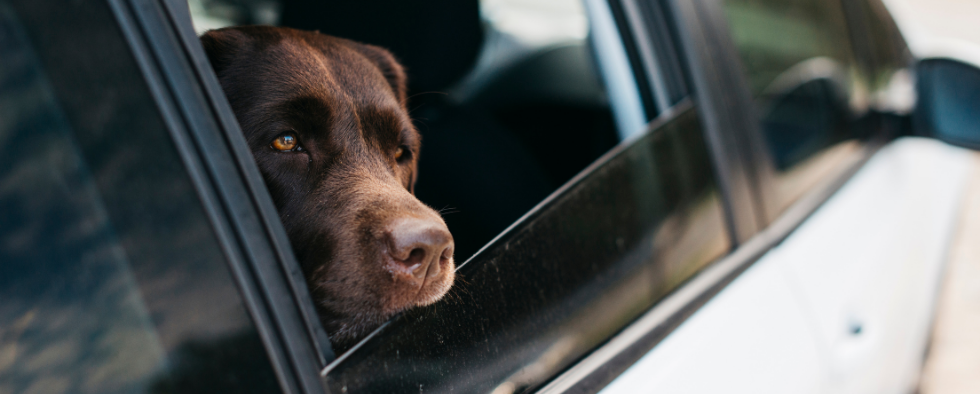
It is the law to restrain your dog when travelling in your car. So as fun as it is for your pooch to sit with their head out of the window, they must be suitably restrained so they cannot distract you and potentially hurt either you or themselves. When it comes to where your dog should be when travelling, although there are no laws against your dog travelling in the footwell of the car, unfortunately they would not be properly restrained and if you did have an accident, you may be prosecuted for ‘dangerous driving’.
When choosing where your dog should be properly restrained, no matter what method you choose, your dog should not sit in the front seat - securing them in the boot or back seat behind a front seat is considered a safer option.
How To Secure A Dog In The Car
There are many safety products you can choose from, which can help with travelling safely in the car. It’s most important you choose a solution that’s suitable and comfortable for your pooch, and it has been installed and executed correctly to ensure the safety of your pet. Here at Lords & Labradors, we’d recommend the following for safe travel.
Dog Carriers
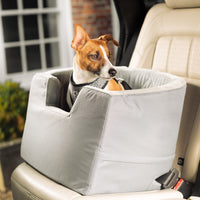
Our pet carriers come in different sizes and weights which will vary for the suitability for you and your dog. It’s a lighter option to our metal crates and are easily packed away if you’re staying away from home. Carriers are great when travelling by car and when taking your dog from the car into a safe place to let them out and stretch their legs. They keep your pooch safe and settled whilst travelling.
Travel Harnesses
Our pet-friendly harnesses come in a variety of sizes, suitable to your dogs breed and size. Travel harnesses are easy to fit onto your dog and it’s quick to clip them into place. They’re specially designed to prevent your dog from moving around whilst in the car, all whilst keeping your pet safe and comfortably restrained.
Travel Crates
Crating your dog keeps them safe & secure - using a crate to transport your pet has the added benefit if they’re already used to being crated at home. If your dog is used to being crated, often when travelling they’ll feel safer and their surroundings will reduce any anxiety your dog may have around travelling.
How Long Can A Dog Travel In A Car
Being stuck in the car can be hard for your dog! Not only will your dog need regular toilet breaks, they’ll also need to stretch their legs and get some of their energy out. When stopping for your dog to toilet and stretch their legs, you could also give them some food and water to avoid any spillages whilst travelling. Ideally you should try to keep to your dogs routine where possible (even when travelling) - every 2 to 4 hours for about 15 to 30 minutes is a good guide to follow, however you’ll know what is best for your dog and how they travel. If you’re planning a lengthy trip, try to go on few shorter journeys to see how your dog is likely to react.
You may be preparing for the all important ‘Gotcha Day’, the day celebrated by all dog parents as the day you brought your pup home. Taking your puppy home for the first time is exciting, especially if you have prepared for their arrival. Puppy shopping can be so much fun, but also overwhelming if you’re a new pet parent, or if you’ve not had a puppy for a few years. There will be some things you do need to buy for necessity and some things that are worth buying for your new pup. Here at Lords & Labradors we’ve put together the 10 puppy essentials you’ll need to get your new puppy settled.
Our Top 10 Items To Buy For Your New Puppy
1) What crate to buy?
Firstly, if you’ve decided to crate train your puppy, you’ll need a crate that will see you through from puppyhood to adulthood. You’ll need a crate the appropriate size so you can fit a puppy bed at one end and a puppy training pad the other incase they need to toilet when left in their crate. It also gives your pup enough room to stretch, play and sleep if crated during the daytime. Depending on your training methods, you may want to place the crate somewhere the puppy can be near to you, but also not directly in a high traffic area of your home. Remember the crate is your puppy’s den, so discourage any children from climbing inside.
2) Where should my puppy sleep?
We recommend a puppy bed that’s easy for your pup to get in and gives them enough support and comfort whilst they sleep. Our Cosy & Calm Puppy Box Beds have been carefully designed with your puppy in mind. The beds are super squishy and soft, and have the most comfortable sides for your pup to snuggle right into. If you have chosen to crate train your pup, our vet bed is really popular, as it’s cosy, comfortable, robust and relatively puppy proof - it’s easily washed and dried too. It can be used with or without our Cosy & Calm puppy box bed.
3) What will my new puppy eat?
It’s recommended you initially use the same food that your puppy comes home with, in order to avoid any tummy upset during their first few days with you. Once your puppy has settled, you can gradually introduce a new food to their diet. It’s good to check the food guidelines of the food you choose to feed your pup, as often they’ll give you the correct guidelines on how to introduce the new food to your pup.
Make sure you have a clean bowl for water and a clean bowl for food, you can opt for a slanted water bowl if you have a spaniel breed to reduce your dogs ears from getting soaked in their water.
4) Puppy Toilet Training
Top of your list should be a reliable pack of puppy training pads, not only are they great for training your young pup, but they are invaluable when travelling (pop in the bottom of their carrier/crate to catch any travel sickness or accidental toilet trips). You can also use them to absorb muddy, wet paws after your pup has had a play in puddles!
5) How to settle my new puppy at night
When settling your new puppy at night, our heart beat sheep will be your puppy's new best friend. The heart beat sheep features a beating heart inside that mimics the beat of Mum's heart. They're designed to offer comfort and calm to new puppies who may feel nervous in their new home; they help to stop separation anxiety too. Alongside the heart beat sheep, you could pop in a heat pad under your dogs bed/cushion to keep them warm and to mimic the feeling of having siblings/mum near. Both the heat and the heart beat sheep will provide comfort for your puppy, especially whilst they are settling in and adjusting overnight.
6) How to keep your new puppy entertained
Toys will provide something to chew on for your pup, which you’ll find are essential if you want to avoid your puppy chewing on your furniture. Choose a variety of textures, styles and sizes to keep your puppy engaged and interested. You may want to keep a toy box so your pup can choose what they’d like to play with, or keep a few toys in rotation so your puppy doesn’t get bored with them.
You can also buy toys you can fill with treats or their food. If you want/need to leave your puppy - remember to build this up slowly, and don’t leave your new puppy for a long period of time - you could try freezing a peanut butter filled KONG (remember to use doggy/puppy friendly peanut butter). Freezing the toy will take them longer to work through and will give some relief to their sore teething gums and teeth.
7) Does my new puppy need a collar?
You may want to purchase your dogs collar before they arrive home with you, however it’s advised to purchase the correct size collar for your puppy, which you may have to wait until they’re here to measure them properly. It is a legal requirement to have a tag with your details on incase your puppy gets lost or strays away, but it’s advised not to add your puppy’s name to the tag.
8) How will I get my new puppy home?
Collecting your puppy to take them home is really exciting, but it’s best to be prepared. Make sure you have a suitable carrier/crate to store them in safely for the journey. It’s important your dog is restrained as it is the law to keep your puppy properly restrained whilst driving. In your carrier, you may want to pop in a blanket that smells like home and a scent blanket that smells like their mum and litter mates. It’s also good to have some puppy training pads to hand incase of any car sickness or accidental toilet trips.
9) When to start training my new puppy?
You can start with bonding and training your puppy almost straight away, get some high quality, puppy training treats (make sure to check the guidelines), and enjoy teaching them new tricks - you’ll be amazed at how quick they learn!
10) When do I start grooming my puppy?
It’s recommend that even if your pup won’t require grooming at first, you should regularly brush them to get them used to being groomed and handled. Choose a simple, soft brush and/or comb for the first couple of months. There will be a time you will need to wash your puppy, make sure you’re not using human shampoo as this will upset your puppy's PH levels and may not be compatible with your puppy flea treatment. It’s best to invest in a puppy shampoo that you can use when and if you need to bathe your puppy. We have our own puppy grooming set in our Petplex collection called the 'Puppy Purifier' it has a shampoo and a cologne to help keep your puppy smelling fresh.
If you’re anything like us you’ll want your furry friend to look their best, we know that grooming is an essential part in achieving that. Frequent dog grooming helps to keep your dog looking nice, as well as improving their overall health and wellbeing. But you may be wondering how often you should groom your dog. In this week’s blog post, we’re covering everything you need to know about dog grooming.
What Is Dog Grooming
Before we look at how often you should be grooming your dog, let’s look at what dog grooming is. If you’re a first-time dog owner or new to dog grooming we know that keeping on top of your dog’s grooming can be overwhelming which is why we’re here to help.
Dog grooming refers to maintaining your dog’s physical coat and hygiene, which includes everything you do to maintain your dog’s coat, skin, nails and ears, from bathing & brushing to cutting and clipping. For a more detail guide on ‘what dog grooming is’, check out this article from our Information Hub - it looks at everything from what is involved in dog grooming, why it’s important and how long it takes. It’s a great place to start if you’re new to dog grooming or need a refresher.
How Often Should A Dog Be Groomed
Understanding your dog’s coat type is the first step in knowing how often to groom your dog and what the best products to use are. How often to groom a dog, in our experience, will depend on things like hair length, texture, and density of your dog’s coat.
The main types of dog coats are: Short or smooth-haired, Long Haired, Double Coated, Curly and Hairless. In this guide, we break down exactly how often each type of coat needs grooming, as well as give you our top tips for looking after their coat and our favourite products.
How Often Should A Long-Haired Dog Be Groomed?
Long-Haired Dogs include breeds such as Lhasa Apso, German Shepherd, Long-Haired Chihuahuas, Dachshunds & Shih Tzus.
Long Hair coats need regular grooming to prevent matting and tangles, daily brushing will help with this and will remove any debris. If you’ve got a long-haired puppy it’s a good idea to get them used to being brushed from the day you bring them home so they’re desensitised to it from a young age.
When it comes to bathing your long-haired dog, it’s important to keep them clean but also not strip their coat from any natural oils that are keeping it shiny and healthy. In our experience bathing your long-haired dog every 6-8 weeks helps keep their coat in tip-top shape. You can either do this at home or take them to a professional groomer for a bath.
When it comes to cutting your long-haired dog it will depend on your personal taste, lifestyle and season. How short you will want to keep your long-haired dog’s coat will depend on your taste and lifestyle, the typical long-haired cuts you’ll see at Crufts are usually what is considered ‘breed standard’. But if you’re not planning on showing your dog in the show ring any time soon, maybe a shorter more practical cut might suit them more. We’d recommend visiting your groomers for a trim every 2 - 3 months, however, they will advise exactly how often they recommend for your particular lang-haired breed.
For long-haired dogs, we recommend the PetPlex Dirt Defeater collection and a slicker brush. The PetPlex Dirt Defeater collection includes a shampoo, conditioner, and cologne so is perfect for removing any tangles and keeping your dog smelling fresh.
How Often Should A Short-Haired Dog Be Groomed?
Short-Haired dogs include Beagles, Boxers, Dalmatians, Great Danes, Pugs & Rhodesian Ridgebacks.
Short-Haired dog breeds typically need less grooming than their long-haired cousins. In our experience brushing their coats once a week is plenty to help keep them healthy and free of debris.
Short-haired dogs will only need occasional baths, every 4-6 weeks or after a particularly mucky walk.
Short-haired dogs likely won’t need regular haircuts with a professional groomer, although some breeds may still need their undercoat stripped away. Contrary to popular belief, short-haired dogs can shed a lot, particularly when the seasons change. Some groomers will offer a specific short-haired dog package which will include a bath and a deshed which will help remove some of that excess hair and keep your short-haired dog’s coat in top shape.
For short-haired dogs we recommend using a gentle shampoo like the PetPlex Dirt Defeater Collection and a good brush, we like the Rosewood 2-in-1 Bath & Groom Brush as you can put shampoo in the top to dispense at bath time making grooming your dog super easy.
How Often Should A Double Coated Dog Be Groomed?
Double dog breeds include wire-haired breeds such as Border Terriers, Brussels Griffons, Jack Russel Terriers, and Schnauzers, as well as breeds such as Golden Retrievers, Labrador, Pomeranians, and Border Collies.
A double coat on a dog is simply a coat that has two layers, they have an undercoat of dense short hairs and then a top coat of longer hairs or guard hairs. The double coat is great for keeping your dog’s temperature regulated and repelling moisture and dirt.
Double-coated breeds shed a lot, especially in Spring and Fall. Although regular grooming won’t stop this it will certainly help minimise it and keep their coats looking healthy. We recommend brushing double-coated dogs 2-3 times a week - this will help remove debris, any mats or tangles, as well as help to remove some of that excess dead hair that may be irritating them.
A common misconception is that shaving your double-coated dog will help keep them cooler in the summer, however, the opposite is actually true. A double-coated dog is insulated in the follicles rather than by the hair, so when you cut their hair all the insulation is still there, and when the hair grows back quite often 10-14 hairs will grow in the place of each follicle rather than the 5-7 that was there before, which can change the texture of their hair and cause bald patches.
We recommend bathing your double-coated dog roughly every 8-12 weeks. Bathing them more frequently in the summer is a good idea as they will be shedding more and it will help to get rid of some of that excess hair.
When it comes to how often you should be taking your double-coat, it can vary depending on if they’re a short, medium, or long-haired double-coated dog but typically we’d recommend at least four times a year to help de-shed all that dead hair. Your local professional groomer will be able to advise the best length of time for your specific breed of dog.
For your double-coated dog, we recommend a good brush to help them shed that bottom coat, both a slicker brush or an undercoat rake work well.
How Often Should You Groom Your Wavy Or Curly-Haired Dog
Wavy or Curly Haired dogs include a lot of the popular poodle cross breeds such as Labradoodles, Cockapoos, Cavapoo & Cavapoochons, as well as breeds such as Bichon Frise, Spanish Waterdogs, Bedlington Terriers, and Poodles.
Although curly coat breeds are typically low shedding they still require maintenance. The curly texture can be prone to matting and tangling so daily brushing will help keep on top of this, especially after a particularly muddy or wet walk.
When it comes to bathing your curly-haired dogs, you want to avoid doing it too often so that their natural essential oils don’t get stripped from their skin and fur. On average, we recommend at most once a month but ideally every 6 weeks or so, the Dexas Mudbuster is perfect for keeping your curly-haired dog’s paws clean between baths.
Curly-haired dogs are more likely to need a regular trim than other breeds, for this, we recommend taking them to a professional groomer every 6 weeks to keep on top of it.
If you want to bathe your dog at home the PetPlex Curl Perfector Shampoo and Detangling Spray work amazingly on both curly and wavy-haired dogs. The shampoo has been specially formulated for dogs with curly coats and has added wheat protein which will strengthen your dog's hair from the root and give instant voluminous results. A detangling spray can either be used on hair wash day or to help freshen up between full grooms, and it will just help to gently tease away knots and tangles. Other grooming kit essentials for a curly-haired dog include a slicker brush and some thinning scissors to help keep the hair round their eyes neat and tidy between trims.
How Often To Groom A Hairless Dog
Hairless Dog Breeds include Chinese Crested Dogs, Hairless Chihuahuas, American Hairless Terriers, and Xoloitzcuintli.
Needless to say, hairless dogs won’t need brushing or trimming like other coat types but they will still need regular baths and it’s a good idea to brush through any patches of hair they may have. With hairless dogs typically an oily film will form after a couple of weeks, this is a good indication that they’re ready to be bathed.
We recommend a really gentle shampoo to bathe your hairless dog with, like PetPlex Derma Doctor which is fragrance-free and full of mild ingredients so it perfect for hairless dogs
How often you should groom your dog will depend on their breed and coat type. Regular grooming at home is essential for all coat types to help their coats in top shape. If you would like a little bit more information on how to groom a dog why not check out our recent Information Hub article? It’s a simple guide explaining everything you need to know to groom your dog at home.
We know there is nothing better than a snuggle with your pooch in bed, but it’s not so ideal when they’re up, pacing and circling, at 3am trying to get a comfortable spot right in the middle of your bed.
Like most dogs, your pooch will have a family member they’d like to sleep with, however this shouldn’t mean you’ve got to give up your bed for them to get comfy too. You can even train your dog to sleep outside of your room if required, but most importantly, they settle on their nice and comfy bed, and that’s where they stay until morning.
In this blog, we discuss how to get your dog to fall asleep in their bed, and not share yours each night.
How To Teach A Dog To Go To Bed
Training your dog to go to sleep in their own bed is made easy when they’ve got a comfy, supportive bed and they have a repetitive routine. Make sure you’ve done some research into the correct bed, you can find more information on choosing your dog bed in our How To Choose A Dog Bed. It’ll take some time to train your dog to sleep in their bed, unfortunately, it won’t happen overnight, but doing so will be a big reward for you and your pup.
If your dog is used to sleeping in your bed with you, consider the placement of their bed before you start training them out of your bed and into sleeping in their own. Your pooch will feel similarity and safety when hearing your breathing whilst you sleep. Once you’ve bought the correct size and shape bed for your dog, you’ll need treats and patience to train them into sleeping in their own bed.
How To Get A Dog To Sleep In A Dog Bed
Your first step is to get a dog bed that your dog is happy to sleep in and is comfortable for them. If they’re a stretched-out sleeper, a mattress style bed will more comfortable. If they sleep in a ball, then opt for a high wall bed instead.
Secondly, choose the spot your dog will feel comfortable sleeping in - make sure it’s where the bed will stay permanently and it will always be accessible when it is bedtime.
Set a command you say to your dog each evening when it’s bedtime. When you use the command, make sure you’re giving your dog a treat when they get onto their bed. It’s good to practice this command, some may use ‘go to bed’ or ‘on your bed’, when you want your dog to lie in their bed. Practicing throughout the day will help install the command at night too.
When it’s time to go to bed, give your pooch their command, encourage them to get into their bed and then give them a treat. It may take a couple of nights to get this right, but they should pick it up fairly quickly.
If your dog leaves their bed during the night, ask them to get back onto their bed and offer a treat. If they wake again, do not give them a treat, simply use the command and ask them to get onto their bed.
If your dog prefers toys to treats, you could offer them a special bedtime toy they’ll love instead of a treat as a reward.
What Dog Bed Should I Buy?
Our dog beds are split into the following categories, Donut Beds, Box Beds, High Wall Beds, Mattress Beds & Puppy Beds. Although there is a lot to choose from, finding the correct bed for your dog is invaluable to both you and your pooch.
Donut Beds
Donut beds are especially good for dogs with anxiety, often the soft, pillow-like cushioning will relax and soothe your dog, which makes a great ‘bedtime’ bed.
Choosing a well-stuffed donut bed with durable fabric will ensure your pooch gets just the right amount of head and neck support whilst they sleep or relax. They’re best for dogs who love to curl up when sleeping.
Box Beds
Box beds are great for dogs who like to sleep in lots of different positions. The sides offer a comfortable head pillow when required, they can get cosy inside the bed curled up should they want to and they can also easily stretch out without pushing against the side of the bed.
Our box beds are made with durable, washable materials, with supportive stuffing to ensure the utmost comfort for your furry friend.
High Wall Beds
High walled beds are particularly good for dogs who love to cuddle up to something. The high sided walls gives them security and warmth whilst they sleep. If your dog loves to hang their head over the side of the bed too, this could be a great option for them.
Mattress Beds
Dogs who love to stretch out may love sleeping on the floor, but with a mattress bed, you can provide the support they need as well as letting them stretch out and enjoy their sleep.
Mattress beds are great for dogs struggling with arthritis or stiff joints as they’re easy to get onto and provide the right amount of firmness and support, there are even orthopaedic options for extra support.
Puppy Beds
Our puppy beds are designed for all breeds in mind, ranging a variety of different sizes and two different shapes.
Our Grow With Me beds are a great 2 in 1 bed for your pup to help them settle in, they're round with high sides so are great for snuggling in up in and they also have a removable inner ring so the bed can grow with them. Our other style of puppy beds are our cosy and calming puppy crate beds, these have been designed with puppy training in mind.
Our cosy & calming beds fill just over half of a dog crate so are perfect to help crate train and toilet train your puppy. The beds also work great as stand alone beds and have plush cosy sides perfect for puppies to rest their heads on. Puppy’s need support and warmth which our Lords & Labradors puppy beds all provide.
We’ve officially had the first day of Spring; and the milder weather has meant our dog walks have been getting a little longer. There are so many reasons to get out and about with your dog at this time of year, and with lockdown restrictions soon to ease slightly we’re all going to be spending more time outdoors.
In a recent article we talked about our favourite dog harnesses and we hope that proved helpful for many of you. This week we’re continuing on the walking accessory theme with dog coats. They come in so many different styles that it can be hard to choose from the vast array out there.
Here we’re going to highlight our favourite dog coats for Springtime. Whilst Spring tends to be mild with periods of sunshine, it can also have cool spells and the odd shower. Having the relevant accessories on hand is a must.
Here are our top picks:
Our Top 5 Dog Coats For Spring
1. King’s Coronation Dog Coat & Miniature Dachshund Coat - Best Made To Measure Dog Coats
The latest addition to our coat range is our limited edition King’s Coronation dog coats, they come in a fun Union Jack print so are perfect for any street parties or bank holiday walks. These gorgeous yet practical dog coats come in both a specialist Miniature Dachshund coat and a dog coat for all breeds. They come in multiple sizes and can also be made to measure, just get in contact with our team on +44 (0)1790 720 900 or sales@lordsandlabradors.co.uk Your little four-legged friend will look super stylish and stay warm in these cute limited edition coats.
2. Barbour Wax Dog Coat - Best Luxury Dog Coat
Barbour wax jackets are a staple in our own Spring wardrobes here at L&L so why not make them part of your dog’s wardrobe too? If your dog is more ‘countryside chic’ than ‘city sleek’, this jacket is the perfect choice. This wax jacket design by Barbour is a durable piece and comes in a choice of three colours so will coordinate with your Barbour jacket perfectly. A practical way to stay dry in the wet weather, it has classic details such as a tartan lining and a cord collar
3. Lords & Labradors Bamboo Drying Coat - Best Dog Coat For Soggy Dogs
Our bamboo drying coats are quickly becoming one of our best sellers and it’s easy to see why. Made out of a double layered bamboo fabric they are perfect for wicking the water away after a wet walk, a paddle in the sea or a bubbly bath time. They come in four classic colours and five sizes so will fit both dainty tea cup breeds as well as large breeds such a German Sheppards and Golden Retrievers. Complete the drying set with our drying mitts and cushion covers to make drying your dog as easy as possible!
4. Hugo & Hudson Rain Jacket - Best Dog Coat For Spring Showers
These lightweight rain jackets from Hugo & Hudson are perfect for Spring Showers. They are fully water resistant to keep your dog dry, and even have a hood to help keep their ears dry! They come in a choice of three colours, a practical navy which will match with everything, as well as some fun spring options with their bright yellow and red colours. All of them have a contrasting stylish striped lining to help keep your dog warm and they come in 7 sizes so you’re sure to find the perfect fitting coat
5. Joules Water Resistant Bee Print Raincoat - Best Budget Spring Dog Coat
If you’re on a budget but still want your pooch to look stylish then this Joules Bee Print Raincoat is the pawfect choice. In a stylish olive colour with a fun bee print all over, your dog will be the most stylish one in the park with this coat! It’s water resistant and has a lead attachment cut out so is perfect for showery spring walks.
We hope you like our selection of Spring Dog Coats. There is something here for every kind of dog and lifestyle. If you need any more product information and can't find it on the individual product pages, please do get in touch. We're always happy to help!
With the weather finally starting to get a little brighter and warmer, if you’re anything like us you’ll be looking to go on some longer dog walks and days out with your furry friends. Collars are an essential for any trip out with your dog but we know that choosing the right collar for your dog can be overwhelming. In this guide, we’ll discuss how to pick the perfect dog collar, how to fit a collar correctly and what the correct tightness should be.
Does My Dog Need A Collar?
It’s now a legal requirement for all dogs to wear a collar when they’re in public places with an ID tag attached, so whilst you may not choose to put one on your dog at home they will need one for whilst you’re out and about even if you prefer to walk them on a harness.
How To Choose A Dog Collar
When choosing a dog collar there are a few factors to consider
Material
Style
Your dog’s breed
Purpose
Which material dog collar to choose
The main materials dog collars are fabric collars which are usually made from nylon or polyester, leather or faux-leather dog collars, metal dog collars and rope dog collars. Which material you pick will depend on your dog. Nylon collars are lightweight, easy to clean and often come in fun designs, where as leather collars are more durable and often softer on your dog’s coat. If you’re looking for a leather dog collar, our leather dog collar guide rounds up our leather collars and talks you through which one to pick for your dog.
Which style of dog collar to pick
Dog collars also come in different styles, some fasten with a buckle whereas others use a clip. The choice of fastening tends to be personal preference, buckles tend to be a bit longer lasting and more sturdy, whereas clips are quicker and easier to get on and off your dog.
The most popular style of collar is a flat collar which sits flush with your dog’s neck. The flat surface helps to distribute pressure evenly on your dog’s neck so is a good choice if your dog likes to pull.
Rounded collars, which are usually leather or rope, are great for dogs with long coats or who get irritated by traditional flat collars, the round shape is more gentle on their necks.
There are also collars which have been designed especially for hounds and whippets. These are thicker at the back of the collar and fasten with a buckle at the front. They have been designed especially for long necked breeds to provide comfort and support whilst they’re walking
Slip Leads, as the name suggests, are easy to slip on and off your dogs. These act as both a collar and a lead and will simply slide over your dog’s head. They’re usually used for gun dogs, however if your dog has a tendency to pull then these might not be the best choice for them as the collar size will tighten as they pull which can put unnecessary pressure on their neck.
Which dog collar to pick for my breed of dog
As we mentioned above the breed of your dog can also influence the style of collar you pick, with hound collars being better for long necked breeds and round collars better for long haired breeds. If you have a smaller breed or a puppy we recommend a lighter weight collar like a nylon collar so that it’s not too heavy for them and putting extra pressure and weight on their neck. Whereas for larger dogs you probably are better looking at something more durable such as a leather collar as they will naturally put more stress on the collar if they pull on it at all and are likely to want the support that a leather collar offers.
Dog Collar Purpose
Hopefully the above has given you a little more information about what collar to pick for your dog but the last thing to think about is purpose. If you’re just using your dog’s collar to hold their ID tag and are planning to either let them walk off lead or use a harness to walk them, then you’re probably okay with a lightweight collar, perhaps a nylon collar. Whereas if you’re going to use the collar to attach your dog’s lead to then maybe a leather dog collar may be more fit for purpose.
How To Fit A Dog Collar Correctly
Once you’ve decided what style and material of collar you want all that’s left to do is pick the right size collar - don’t worry we know that’s easier said that done which is why we have created a guide to help you measure a dog collar. We’ve put the basics below but if you’re looking for a little more information check out our handy guide here
Get a fabric tape measure and place it round your dog’s neck where their collar would usually sit
Place two fingers between the measuring tape and your dog’s neck
Take the measurement and add one to two inches
Use this measurement when looking at size guides for your dog’s collar - if your dog sits at the top of one size range and the bottom of another we recommend picking the one they sit at the bottom of.
How to pick a size of collar for a puppy
In the first few months of your puppies lives they’re likely to go through a few collars as they grow so quickly. When it comes to measuring your puppy for a collar follow the same steps as above but keep in mind how quickly they grow in those first few weeks.
As we mentioned above we usually recommend lightweight nylon collars for puppies, these are usually super adjustable so are perfect for growing puppies. Getting your puppy used to wearing a collar even before they go out for their first walk can really help them, their first walk will be daunting for them so by getting them used to a collar as early as possible will help it be a little less scary for them.
Many breeders use whelping collars, which are brightly coloured lightweight collars, to help identify the pups in the first few weeks but are also great for getting puppies used to wearing collars.
What Is The Correct Tightness Of Dog Collar
Knowing how tight to make your dog’s collar can be tricky sometimes, it needs to be tight enough so that they can’t easily escape it but loose enough that it’s not hurting their neck. The general rule of thumb is make sure that you can fit two fingers between your dog’s collar and their neck.
We hope this guide has helped you pick the perfect collar for your pooch, don’t forget to check out our range of designer dog collars - we’re sure to have something to suit your dog.
Adding a pet into the equation is a big step for any relationship, as this holds a whole new level of responsibility and commitment for both sides.
Though parenting a pet is a highly rewarding and entertaining experience for couples, these loveable creatures require a lot of love and attention – alongside caring for both yourself and your partner too!
Whether you’ve adopted a cat, a dog, or both, finding the perfect balance of caring for your significant other and your pet can prove difficult for many, and failing to set some much-needed rules and boundaries for your four-legged friend, especially when it comes to sleeping arrangements, can have a significant impact on the happiness of all involved.
With this in mind, we conducted a study to find out how the sleeping habits of the nation’s beloved pets are impacting their sex lives, as well as examining how many UK adults admit to putting their love for their pet above their partner.
How are the nation’s pets affecting Brits’ intimacy?
Upon analysing the data, it’s clear to see that our four-legged friends can act as a hinderance when it comes to having intimate moments with a lover, as four in ten Brits stated that allowing their furry friends to sleep on the bed has affected their sex life in some way (41%).
Though it seems that stubborn pets and their preferred place to snooze are not the only ones to blame, as the findings revealed that nearly one million UK adults across the nation (832,557)* admit to using their pet sleeping on the bed as an excuse not to have sex with their partner.
Emotions play a big part here too, it seems, as one in nine (11%) confessed that their pet’s sleeping arrangements have affected their sex life as they feel too guilty to move their pet when they find them napping on the bed. In fact, a fifth will only actually have sex if they can actually bring themselves to move their snoozing pet (23%) from the bed.
In terms of who’s more likely to move their sleepy pooch in order to make time for some much-needed intimacy, double the number of women (14%) admitted to having less sex because they feel guilty moving their sleeping pet from the bed than men (7%).
Though it’s not all bad news for loved-up Brits, as six percent of those surveyed said that their pet sleeping on the bed has encouraged them to get more creative with their sex lives, exploring different places around the home rather than moving the sleeping cat or dog.
Belfast residents have their sex lives affected the most by sleeping pets
When examining regional-specific data, Belfast was found to have the highest percentage of residents who said their pet sleeping on their bed had affected their sex lives in some way (61%), followed by Glasgow and Manchester (both 55%).
Also high up on the list of the cities were Edinburgh (48%) and London (47%), with almost half of residents within each of the cities having had their sex lives affected by their sleepy pets occupying the bed.
In contrast to this, Norwich had the lowest percentage of affected residents (17%), followed by Liverpool (26%) and Southampton (28%).
UK City
% of residents who say their pet sleeping on their bed has affected their sex life in some way
Belfast
61%
Glasgow
55%
Manchester
55%
Edinburgh
48%
London
47%
Bristol
44%
Leeds
41%
Cardiff
40%
Birmingham
33%
Nottingham
33%
Sheffield
32%
Newcastle
30%
Southampton
28%
Liverpool
26%
Norwich
17%
We spoke with Dennis Relojo-Howell, Managing Director of Psychreg, who shared his insight as to why we feel so guilty when it comes to our pets, and why it is integral to set boundaries:
“Pets hold a special place in our lives due to several reasons. First, they offer companionship and unconditional love – fulfilling our innate need for social connection. This bond can be so strong that it sometimes rivals our relationships with fellow humans.
“Second, as a myriad of research has shown, pets help reduce stress and anxiety by offering a soothing presence, which can lead to the release of oxytocin, a hormone associated with social bonding and trust. This creates a positive feedback loop, further strengthening our attachment to them.
“Pets can also give us a sense of purpose, responsibility, and structure, contributing positively to our mental well-being. However, the deep bond with pets can sometimes affect our relationships, especially when our partners feel left out or when pets become a source of conflict.
“To maintain a healthy balance, it's important to establish clear boundaries with our pets. This can include designated pet-free zones or times when pets are not allowed on furniture or in specific rooms. Ensuring that you prioritise quality time with your partner without the presence of pets is crucial as it helps maintain the emotional connection between you and your partner, reinforcing the importance of your relationship.”
Brits are spending more quality time with their pet each day than their other half, study reveals
We also quizzed participants on the amount of quality time spent with their pet versus that spent with their lover and found that Brits are spending an average of seven hours quality time per day with their pets, versus six hours with their partner.
According to the findings, women are reserving more quality time for their pets (eight hours per day on average), than they are for their other halves (six hours). For men, it was a different story, with six hours of quality time for pets vs. seven hours for partners.
It’s no secret that pets love being spoilt and fussed over, but more than half of Brits (56%) admitted to giving their pets treats more frequently than they do their spouse, and a further half are more likely to use pet names for their four-legged friends too (49%).
More than a third (35%) also admitted to cuddling their beloved pet more often than they do their partner, and a further quarter (28%) even admitted to saying the words “I love you” more frequently to their furry friends!
After a long day at work or on a lazy Sunday afternoon, Brits up and down the country are partial to a quick nap in order to recharge their batteries. However, according to our findings, a quarter (27%) of the nation say they do this more frequently with their pet rather than with their spouse. A further fifth (16%) say they do this equally with both.
That said, 43% of UK adults say they’re more inclined to tell their pet off then they are their other half. For just a fifth (18%), it’s the other way around.
Activity
% of UK adults who do this more with their pet than their partner
Give them treats
56%
Call them pet names
49%
Cuddle them
35%
Tell them I love them
28%
Take a nap with them
27%
Kiss them
26%
Buy gifts for them
25%
Go out for the day together
22%
Go out for food and drinks
18%
Buy them clothes
15%
And they called it puppy love: Women are more likely to pick their pet over their partner
As part of our study, we also wanted to uncover whether Brits would be more inclined to pick either their partner or their pet if forced to do so.
Interestingly, the findings revealed that the UK is a most certainly a nation of loyal pet lovers, with more than one in six UK adults having opted for their pets rather than their partners if forced to choose between the two (16%).
A fifth of those surveyed admitted they’d find it hard to pick between the two (21%), whilst almost one in ten said they’d rather go it alone and opt for neither (9%).
The data highlighted that women are more likely to pick their pet over their partner (18% vs.12% of men). Similarly, more women said they’d struggle to make the decision between their partner and their pet (24% vs, 17% of men).
The cities of Norwich and Sheffield had the highest percentage of residents who say they’d pick their pet over their partner if asked to decide (23%), while those living in Manchester would be more likely to leave both their pet and partner behind and go it alone (24%). Edinburgh was seen to have the highest percentage of respondents who would pick their partner over their pet if asked to make the choice (67%).
How to create all-important boundaries and encourage pets to sleep in their own space
As much as we adore our pets, setting boundaries and sticking to them is an essential part of being a responsible pet owner. And whilst it’s natural to want to ensure your pet feels both loved and appreciated, it’s integral we’re showing our partners how much we love and cherish them too.
If you are able to set clear boundaries with your pet in the bedroom, namely in regard to where your pet goes to sleep at night, this can be hugely beneficial to the relationship you have with your other half, especially when it comes to maintaining a healthy level of intimacy.
Following these rules may help to encourage your pet to sleep in their own space, and hopefully stay there:
Firstly, create a cosy place for them to sleep that they know belongs to them.
This is followed by setting and practising clear commands such as ‘go to bed’ or ‘on your bed’ that you say each night at bedtime can help both of you to get into a good routine.
When using the command, show your pet what you would like them to do and where you would like them to go.
Be consistent and ensure you’re rewarding them when they do follow your lead here.
And, if your dog leaves their bed during the night, ask them to get back onto their bed and offer a treat.
If they wake again, do not give them a treat, simply use the command and ask them to get onto their bed.
Conclusion
At Lords and Labradors, we pride ourselves on putting your pet's wellbeing first. This includes setting healthy boundaries in their home to ensure that your fluffy friends are properly trained and living the best quality of life.
However, this is not to forget that your own personal relationships should not have to experience strain due to your pet’s sleeping habits. After all, a happy home is the best environment for your pooch to reside in.
We hope that this study will prompt you to practice healthy boundaries with your pets, potentially by using some of the tips that are on offer in this article. Why not share some of your pet’s sleeping areas with us on Twitter?
Data Sources:
Survey of 2,000 UK adults conducted in March 2023
* Almost 1million pet owners determined by -
52% of UK adults own a pet, according to PDSA data in 2022
52 % of UK adult population (53,369,083) = 27,751,923.16
3% of pet owners who said they use pet as excuse not to have sex. So 3% of 27,751,923.16 = 832,557
SIGN UP FOR USEFUL TIPS & GUIDES STRAIGHT TO YOUR INBOX
27.03.23March 27, 2023HealthFeatured
Walking Your Dog Safely In Spring
Longer daylight hours, blooming plants, an abundance of life beginning to come out of hibernation; Spring is a wonderful time of year. There are positives to be found in every season, but there is something special about Spring that manages to lift the spirits like no other. Longer days, milder weather and a wash of colour on the landscape will be welcomed by us all.
For dog owners it’s the ideal time to make your dog walks a little longer. Perhaps you’ll find some new routes to explore that will add interest for both you and your four-legged friend. There are a few things to consider when walking your dog in the Springtime. Here we highlight we highlight some of those things so you can plan some new adventures.
Where To Walk Your Dog In Spring
The places that you walk to or around in the Spring may not differ greatly to those in Winter, but what you do on your walk may well change. Here are a couple of places we like to enjoy on our Springtime dog walks:
The Park - Parks are always a brilliant place to take your dog for their daily exercise. Especially parks with open space where they can run and let off some steam. With the milder weather, and hopefully the odd sunny spell, your dog walks in the park could include a game of fetch. Next time you go on your walk, take your dog’s favourite ball or throwing toy and see if you can fit in a fun game to add spice to the outing.
The Woods - Dogs love woodland walks. There are a plethora or sights, sounds and smells in the woods that your dog probably won’t experience on a normal day. If you have some woodland near or can get to a wooded area easily, then Spring is the perfect time to get out and explore.
The Beach - Another landscape that is loved by our canine friends, the beach offers a place to run, and if your dog likes water, to have a good swim. One thing to be aware of is that many beaches will be closed to dogs in the Summer months, so be aware of the beach that you’re visiting and make sure that you’re allowed to visit. There are many dog friendly beaches around the country; the trick is to find the perfect one! Remember to take your dog’s drying coat with you in case they go for a splash and don’t forget a couple of toys. Like any other dog walk, be aware of other people and only let your dog off the lead if it’s safe to do so.
The Countryside - If you live in a rural location then a walk through the countryside can be a joyous adventure for both you and your dog. The landscape around us is full of change at this time of year and your dog will love experiencing the new smells and colours that emerge. Just make sure you stick to the rules of the countryside - stick to public footpaths and always keep your dog on their lead around livestock.
Wherever your adventures take you, always be aware of other people around. If it’s busy keep your dog on their lead and consider saving any games of fetch until next time.
Potential Springtime Hazards
There are a few things to consider when setting out for your Springtime dog walks. Here are a couple to be particularly aware of:
Joggers & Cyclists - Dog walkers like yourselves won’t be the only people making the most of the extended daylight hours, but you’ll probably encounter cyclists, joggers and horse riders more often too. If you see any of these coming, keep your dog on a shortened lead next to you and wait for them to pass safely. The last thing you want is for your dog to chase a cyclist or rider as it could be dangerous for both parties.
Livestock - We did mention this briefly before, but it’s really important that you take note of the animals around you. In Springtime especially, there will be lots of young animals around. Cows with calves can be particularly defensive of their young so it might be best to stick to routes without. Always assess the situation and keep your dog on a lead around farm animals and horses.
Beware of Poisonous Springtime Plants
One of our favourite things about this season is the abundance of wildlife that appears, but this can also be a potential danger to your pets too. Make sure you are aware of what plants and flowers are poisonous to pets and try to keep your dog away from them on your walks. Some plants to avoid are as follows:
• Azalea • Bluebells • Buttercups • Cyclamen (roots) • Daffodils (bulbs) • Foxgloves • Hyacinths (bulbs) • Ivy • Lupins • Rhododendrons • Tulips
If your dog shows signs of being ill and you think they may have ingested something poisonous, seek the advice of your Vet immediately. If you see them eat something you know is poisonous, don’t wait for symptoms to appear, but seek medical advice straight away.
Don’t go too far, too quickly
It might be tempting to make your Springtime dog walks much longer than usual, but It’s important to consider your dog’s fitness. If your dog walks were pretty short during Winter your dog may not be as fit or have the same stamina as they had last Summer. Increase the length of your dog walks gradually so that they can enjoy the experience without getting completely worn out.
Make Sure You Have the Right Equipment and Clothing
It’s easy to focus on what your dog needs for their walks, but don’t forget to consider your own comfort. If you’re going for a walk in the Countryside or the woods, make sure you select the correct footwear and clothing. A good sturdy pair of shoes or trainers (or walking boots in some cases) are essential for uneven terrains.
Also make sure your dog’s walking set is a good fit. A well-fitted harness is a brilliant item for dog walks as it offers greater comfort and control than just using a collar.
Plan Your Dog Walks
Wherever your adventures take you, make sure you plan ahead and take everything that you’ll need with you. And we don’t just mean a walking set, but the other accessories that will make your dog walks go smoothly. Some items that we’d suggest you take include the following:
• Training Treats - always reward good behaviour • Throwing Toy - perfect for the park or beach when it’s quiet • Small Travel Bag - Depending on how long you’re out, it might be worth taking a travel bowl with some fresh water and even some dry food. Your dog may well work up an appetite. • Drying Coat - if your dog likes a splash in the water and you’re going to the beach a drying coat is a great way to keep them warm and dry on the way home. • Dog Coat - Don’t forget those April Showers. A good quality dog coat may be an essential accessory at this time of year.
We hope we’ve given you some great ideas for your upcoming walks. Take note of the hazards we mention and, with a little planning, we’re sure you and your dog will be enjoying some wonderful walks this Spring.
Humans spend a third of their lives in bed, so you probably spent ages choosing the right bed and mattress to make sure that you get the best night’s sleep possible and don’t end up like Goldilocks with a bed that’s not right! But what about choosing the perfect dog bed?
A dog can spend a significant amount of time in their bed, and as a beloved member of your family, your furry friend needs a bed that they’re happy and comfortable with. But how exactly do you choose the right bed for your dog?
For many dogs, their bed is an important part of their lives that helps with relaxing, unwinding and gaining some personal space away from humans and other animals. It may be tempting as a dog owner to allow your pooch to carry out their naps in your bed or on other items of furniture around the house, but as a dog bed offers suitable support to your dog and a sanctuary for them during downtime, it’s important they have one.
In this guide we take a closer look at choosing a dog bed, one that’s perfect for dreaming and sleeping all night long!
Do Dogs Need Beds?
On average, dogs spend between 12 and 18 hours of the day asleep, so a bed that’s comfortable, supportive and suits their needs is key for any dog. It’s only natural that your four-legged friend may choose to take power naps beside you on the sofa or even spend moments sleeping in your bed, but a dog bed is an important asset in any dog’s life and it is often recognised as their own environment for having time by themselves, relaxing and unwinding after a long day causing mischief.
Other benefits to dog beds include:
Contributing to health and comfort
Easing feelings of stress and anxiety
Improving the training process
Offering quality sleep
Preserving condition of human furniture
Preventing behavioural issues
How to choose a dog bed
There are loads of dog beds to choose from here at Lords & Labradors but picking the right bed for your dog can be overwhelming. Fortunately, you can use a few key factors to pick out the best option for your dog based on the breed and size of your dog and how they like to sleep.
The key things to think about when choosing a dog bed are
Size
Sleeping Styles
Comfort
How To Choose A Dog Bed Size
Size plays an important role in deciding the correct bed for your dog. If you have a Dachshund, an extra-large bed designed for sprawling out may be excessive, just as you would be lucky to fit any part of a Doberman in a small igloo bed.
A dog bed needs to be big enough for them to comfortably lie in all their favourite positions whilst still being small enough for them to feel cosy & safe in. All our dog beds, here at Lords and Labradors, have a size guide which will help give you an idea of which bed we’d recommend for your breed.
Measuring your dog will help to give you an idea of what size dog bed they will need. To do this, wait until they are sleeping and measure them in centimetres from their nose to their back paws. You should then add around 25 centimetres onto the measurement you’ve taken and a bed with a similar length should be ideal for your furry friend.
How To Choose A Dog Bed Style
As well as the size of your dog, how they sleep is also an important factor to consider. Your dog will give you clues about what bed they’d sleep best in and how they like to sleep every single day. Some dogs love to stretch out, whereas other dogs love to curl up with their nose touching their tail. Here we talk you through the different styles of dog bed and what sleep style they suit.
Mattress Beds/Cushions
Is your dog a side sleeper? Do they love to sprawl out whilst sleeping? Maybe a cushion or a mattress bed is for them, this will give them the space to stretch out whilst still being super comfy. Our crate cushions also work great as standalone cushions for dogs who love their sleep space.
High Wall Beds
The tall squishy walls of a high wall bed are great for dogs who love something to rest their head on whilst still curling up . The high sides will help to keep them feeling safe and secure, so they can really get cosy during nap time. Our high wall beds have a lowered front edge so it’s easy for your dog to get in and out.
Donut Beds
Donut beds as the name suggest are a circle shape with a raised ring round the side. These are great dog bed for dogs who suffer with anxiety and like to curl up in their bed to unwind, the cosy sides will cocoon them and make them feel safe. We’ve made our donut beds with the most sumptuously soft faux fur so it’s perfect for snuggling up in for those all important naps.
Box Beds
Does your dog like to stretch out but still love something to rest their head on? A dog box bed is a perfect choice for them. The square shape means they’ve got plenty of space to stretch out but the padded edges are soft and perfect for hanging their head off whilst napping.
Orthopaedic Beds
Just like we can get orthopaedic mattresses, you can get orthopaedic dog beds. These are a great choice for dogs who have specific health needs, like joint problems or senior dogs who need a little more support. The foam inner on our L&L Orthopaedic mattress has been designed to provide plenty of support for dogs who need it. They’re also low to the floor so they’re easy for dogs with aches and pains to get on and off.
Den Beds
Does your dog like to burrow and hide? Breeds such as Dachshunds and Jack Russels were bred to go to ground when hunting so have a natural instinct to tunnel and burrow, so a den bed is perfect for them. Our den beds are round and have a comfy cushions so are perfect for curling up in but the attached blanket means they can hide and burrow before settling down to sleep.
Picking the perfect puppy bed
Are you getting a new puppy? You’ll probably want to get them a puppy bed before transitioning to an adult bed. Puppy beds are usually slightly smaller than the adult beds to stop your puppy from feeling lost in their new bed. We have two styles of puppy beds here at L&L, both of which have been tested with our own puppies to make sure they’re fit for purpose
Cosy & Calming Puppy Crate Bed
Our cosy & calming puppy beds are exactly as the name suggests, cosy and calming. They have been designed to fill just over half of a dog crate so if you’re crate training your puppy this will help divide their crate and aid their toilet training. The rectangle beds have padded raised walls all the way round for your puppy to snuggle up in and the cushion in the middle is made from the softest fleece, perfect for all those naps your puppy needs!
Grow With Me Puppy Beds
Our newest addition to our bed range, the grow with me puppy beds have high walls to create a feeling of security for nervous puppies. They feature a soft removable ring which you can take out as your puppy grows. This means the bed is never too big for your puppy and it can grow with them. This is perfect dog bed to choose for more nervous puppies or puppies who love to be cocooned and curled up
Do dogs need soft beds?
Dog beds are available in a selection of different materials, so it’s important you choose the most suitable option for your dog. A dog bed needs to be firm enough to offer support to your dog but comfortable enough to make them feel cosy and relaxed.
For puppies, a super soft dog bed with sides to prevent them from tumbling out will make them feel more settled, especially if they’ve recently moved into your home. However, this type of bed may be too small to fit a larger dog, and as older dogs may struggle to get out of a bed that’s particularly spongy, a dog cushion would be more fitting, and it would help to support their ageing joints.
For more destructive dogs you might want a dog bed that’s made out of something more hardwearing, like our Rhino Tough faux-leather beds, rather than a soft furry beds!
How Long Do Dog Beds Last?
Whether your dog is prone to bringing snacks to bed, walking mud all over their bed or scratching at it and kneading it until it feels exactly right, it’s to be expected that it will become damaged and eventually require replacing. A dog bed’s lifespan could be several years if it’s a good quality or a matter of weeks if it’s not.
However, you can extend the time you use a dog bed by washing it as instructed on the label and cleaning away any food or dirt as soon as it comes into contact with it. Dogs are messy creatures by design, but it’s a shame to let them ruin a perfectly good bed, especially if it’s one they’re particularly fond of.
How Often Should You Replace A Dog Bed
As dogs are unpredictable, it’s not always easy to anticipate when they will do something that totally ruins their bed. It may be in good condition for several months before they pull out a thread while scratching it and end up accidentally ripping it open and pulling out all the stuffing. Unfortunately, if this happens, it’s unlikely that you will be able to fix it and the best solution will be to replace it entirely with a new dog bed.
However, you may be wondering when you should give up on your pooch’s bed and invest in a new one. Situations where you should consider replacing your dog bed include when:
It smells and repeated washing isn’t removing the nasty odour
It’s infested with fleas and nothing is working to remove them
The stuffing is falling out, the material is ripped and it’s totally beyond repair.
How Many Dog Beds Should A Dog Have?
All dogs should have at least one bed, but if your dog spends time in different rooms, providing multiple beds can mean that they feel more comfortable in each room and are less inclined to jump on human furniture.
If you have more than one dog, it would be advisable to provide a bed for each of them. However, if they tend to snuggle up together, it could make sense to choose a bed that’s big enough to support both of them.
What Dog Bed Should I Buy?
So, when it comes to identifying the best dog bed for your furry friend, consider their wants and needs and match it with an option that ticks all the right boxes. If your dog is large, check that they’ll fit in the bed. If they’re prone to scratching and digging in their bed, make sure the material is strong enough to withstand this level of wear and tear. If they’re old, pick a bed that’s designed to support them effectively.
If you’re still not sure what dog bed to choose, why not chat to one of our Customer Care team? They’re pet experts with years of knowledge, they can help to advise you on which dog bed will suit your dog!
Still not sure what bed to get your dog? Why not chat to one of our pet experts? They're bed experts and will be able to advise you which bed will be the best fit and shape for your dog, call us on +44 1790 720 900 or email us on sales@lordsandlabradors.co.uk
Top 10 Tips First Time Dog Owners Wish They'd Known
Bringing a new pup home for the very first time is an exciting and special moment for any family. However, when you’re welcoming a dog into your home, there are a lot of things you need to consider, many of which may not have occurred to you beforehand. From finding the perfect place for your canine to sleep to purchasing the right dog toys to make them feel as comfortable as possible, the list can feel almost endless.
Of course, there’re always going to be some things you forget, many of which may be impossible to foresee as they relate to your new furry friend’s individual needs and personality. But in order to make the transition as easy and stress-free as possible for both your family and its new fluffy member, here at Lords & Labradors we turned to our dog-owning social media followers for the top 10 things they wish they had known when they first welcomed a puppy into the family. Spurred on by the chance to win a beautiful doggy hamper worth £100, it’s safe to say our wonderful followers did not disappoint.
Here's what we found out...
Top 10 Puppy Tips
Reading through the hundreds of tips sent in by you, our expert dog-owning followers, it soon became clear that there are three key pieces of advice seasoned dog owners wish they had known prior to welcoming a new pup into the family. These revolve around giving your new four-legged friends plenty of space and letting them settle at their own pace, providing lots of positive encouragement, while also setting boundaries early on, and, of course, showing them lots of love and support right from the get go.
While it can be tempting to mollycoddle and overindulge your new dog in an attempt to make them feel welcome and at home, as our competition winner @ted_cockapoo9 (Instagram) stressed, giving them a little space and time to adjust to their new surroundings by themselves can work wonders for their confidence.
Similarly, setting boundaries and training your dog early on is critical. From not allowing your pup to go upstairs or sit on the furniture and ensuring they behave when they are left alone in the house, setting boundaries through active obedience and separation training will not only set the right family dynamic, but also improve the bond between you and your canine.
1. Give Your Puppy Space
@ted_cockapoo9 points out that giving your new pet a little bit of space when first bringing them home is absolutely key and can help them settle in without feeling stressed or overwhelmed.
“Don’t crowd them or try to over-stimulate them - let them have a sniff around at their new surroundings and if they want to lay in their bed, don’t stress. Every pup is different but most appreciate space to explore”
2. Separation Training
Urban Paws UK stressed the importance of separation training when you first bring your puppy home
“When you leave the house you dog needs to be happy and comfortable with their owner being away. Leaving the dog in a safe room, with a favourite toy and/or treats, will help relate this to a positive experience. Start with 5 minutes and build the time up until the dog is happy to be left on their own”
3. Socialising Your Puppy
Hannah Thompson (Dog Trainer and Behaviourist) believes the most important tip to give new dog owners involves ensuring your four-legged friend is properly socialising them with the help of reassuring sounds from the moment they are welcomed into your family.
She says “I think the biggest one is socialisation. Making encouraging sounds and playing everyday noises to your puppy from the start whilst they’re doing positive things such as playing and eating can help them settle in and grow up as well adjusted dogs”
4. Reassure Your Puppy
@x_athena_the_frenchie_x highlights that although patience is key and giving your new pup a bit of space is important while they settle into their new surroundings, providing lots of verbal reassurance and gradually introducing them to all other members of the family is also key to making them feel right at home.
She says: :Give lots of praise and reassurance, and slowly introduce your pup to their new home. If you have children, explain that a puppy needs to have some quiet time and make sure to place their bed slightly away from the centre of all activity in the room to make sure they are able to sleep when they need it. Also don’t over-stimulate your puppy and remember this is new for them, so there will be accidents aplenty. Patience is key”
5. Research The Breed
Sharon Calvert Wormald believes the key to successful dog ownership is selecting the right breed to best suit your family
She says “Research the best breed to suit your family and circumstances. If you’re active, it’s better to get a breed which also active, such as a Collie or a Spaniel. If you tend to want to relax more, a mellow breed is better. There’s nothing worse than choosing the perfect looking pooch only to be overwhelmed by their exuberant nature or vice versa”
6. Comforting Your Puppy
@sambaird34 points out that making your dog’s new bed as comforting and supportive as possible before their first night’s sleep in your home can make a huge difference in how they settle.
He says “For their first night in their own bed, put a tactile toy in with them, preferably something they had been playing with that day. You may also want to put a warm (not hot) water bottle next to them. If they are used to sleeping near their mother, a source of warmth may comfort your pup”
7. Training Your Puppy On And Off The Lead
Blair Woods believes you can’t look past training from an early age and socialising your dog with other canines
“My tips is something I did do, but I know a lot of people don’t - it’s so important to train your pup from an early age, both on and off the lead. This will allow your dog to mix with other dogs from the puppy stage”
8. Setting Boundaries
When it comes to top tips that first time dog owners need to know, @i_am_buddy_boo stresses the importance of creating boundaries and making sure both you and your furry friend stick to them
“Even when you feel tempted to let them slip occasionally, creating and sticking to set boundaries is so important! It definitely helps your relationship with the dog and they benefit from having these boundaries”
9. Toilet Training
Janis McPhee believes knowing how to properly toilet train your pooch is vital when becoming a first time dog owners. When asked what she wished she had known before welcoming her first pup she she says
“Remember to keep the back door open to let the puppy get used to going outside to pee and poo in the early days. Even though it might be cold, it’s worth it and soon the puppy with simply wait at the closed back door when they know nature is calling”
10. Loving Your Puppy
Karen Evans offers perhaps the most important piece of advice of all when it comes to welcoming a new canine friend into your family. She simply says:
“Love them as they love you”
What advice do you wish you had been given before becoming a first-time dog owner? Let us know on social media using the hashtag #landlfriends or message us!
When it’s cold outside it’s easy for us to flick the heating on, find another layer and cuddle up under the blanket on the sofa, but how do you keep your dog warm in colder months?
Some dogs love to roll in the snow whereas others shiver after being outside for a minute, every dog is different when it comes to the cold.They can’t tell us if they’re too cold so here’s the things to look out for and our top ways of keeping them snuggly this winter
How To Keep A Dog Warm In Winter
Whether winter means snow and ice or slightly milder temperatures, there’s a few steps you can take to keep your dog warm in winter. Even though dogs have furry coats, which do act as a layer of warmth and protection, they can still suffer in the cold.
Do Dogs Get Cold?
Despite descending from wolves, dogs do feel the cold just like us - they aren’t capable of staying in the cold for long periods of time like their wolf ancestors.
Smaller dogs and short haired dogs are much more likely to feel the cold than larger or long haired dogs. Similarly puppies and senior dogs are likely to feel the cold much more than adult dogs as they regulate their body temperatures quite as well.
How Do Dogs Keep Warm
The number one way dogs keep themselves warm is with their fur, as we mentioned this is more the case with longer haired dogs but all dog coats provide a level of insulation.
In cold weather, your dog’s hair will stand up to help trap the heat and act like a blanket to help insulate them.
Another way your dog keeps themselves warm in the winter is through the paws. When we as humans are cold, our body shuts off the blood supply to our hands and feet to protect our vital organs. With dogs, however, the warm blood supply to dogs paws keeps going in the cold. This helps to keep their paws warm and in turn them warm.
How Cold Is Too Cold For A Dog
The answer to this question hugely depends on your dog's breed, if they have a long shaggy coat this will act as an extra layer of insulation to help the cold better than their short-haired counterparts. Long-haired dog breeds that fit this category include:
Siberian Husky
Chow Chow
Bernese Mountain Dog
Collie
New Foundland
Saint Bernard
Alaskan Malamute
Irish Wolfhound
Golden Retriever
Old English Sheepdog
Does your dog have a short coat of hair? They might not be able to handle the cold quite as well, examples of short-haired dogs include:
Bulldog
Yorkshire Terrier
Boxer
Great Dane
Shih Tzu
Boston Terrier
Chihuahua
Beagle
Pug
We’ve put in our handy table to help you work out when it’s too cold to walk your dog outside
What Can I Use To Keep Dogs Warm In Winter?
Warm Cosy Place to sleep - Try moving your dog's bed to the warmest place in the house away from any drafts windows or doors. Then you can add an extra cosy blanket, like our luxury faux fur blankets, for your dog to snuggle up in to help keep them warm this winter.
Coat or a jumper - For shorter-haired breeds as we listed above you could try a snuggly jacket or a coat. These will help add another layer of insulation to your dogs when you’re out for your winter walks. However, not every dog loves wearing a coat, they may need a little time to get used to wearing one but if they don’t love it that’s okay! Simply keep their trips outside short and sweet.
Protect their paws - Dogs paws, ears and nose are much more exposed to the cold than the rest of their body and can be much more sensitive. Chemicals and grit that has been put down to help prevent the ice can actually be an irritant to your dog. If you have walked your dog on an icy or frosty day make sure to check their paws for cracks or bleeding both before and after your walk, if they look irritated why not try Be:loved paw balm?
Shorter Walks - Although your dogs will still need exercising in winter, so we recommend little and often when it comes to walks. Our recent blog ‘Things To Dog With Your Dog At Home’ has some great enrichment activities to help them burn off that excess energy, as does The Blue Cross Guide to Indoor Dog Games
Winter Safety Tips
Whilst you’re doing everything you can to keep your dog warm this winter, there are a few hazards to watch out for to help your pup safe
Watch out for fire places - If you’re anything like us you’ll love curling up in front of a cosy fire with your dog, however, we recommend never leaving your pet unattended whilst you have the fire burning. Also, putting up a safety screen is a great idea to help keep your pets safe from the flames, soot and embers of the fire.
Plug-In Heaters - Similarly to fireplaces you need to be really careful with plug-in heaters around your pets. If your dog or cat gets too close they can get burned or if they happen to knock it over they could start a fire
Keep anti-freeze out of reach and sight - Anti-freeze actually tastes sweet to most dogs however it is highly toxic so make sure you keep it well out of paws-reach. If you suspect they have swallowed some anti-freeze make sure to contact your vet so they can instruct you on what to do next
Don’t leave them alone in the car - Similarly to summer, we advise not leaving your dog on their own in your car in winter when the weather is particularly cold.
How To Keep A Dog Warm At Night
At night is when the temperatures really drop and you’ll want to make sure your dog has a snug and cosy nights sleep. We recommend adding some extra cosy bedding to your dog’s bed to help keep them warm through the winter as well as moving their bed away from any draughty areas of your house. If your dog is a chewer or you have a young puppy, be careful that they don’t chew any extra bedding that you give them!
How To Keep A Dog Warm In A Crate At Night
We designed our crate sets especially with keeping your dog warm and cosy in mind. Our crate sets consist of a crate, cushion, bumper and cover - all designed to keep your dog warm in their crate at night.
The thick cushion is not only comfy to lay on but is thick enough to raise your dog off the ground to help keep them warm
The bumper stops any drafts from coming in the side of your dog's crates as well as provides them with a cosy place to rest their head
Our crate covers have doors which can be rolled down to keep your dog’s crate insulated as well as block any light out
Do Blankets Keep Dogs Warm?
Blankets not only keep your dogs warm but also provide a great deal of comfort to your dog. Adding a new cosy blanket to your dog’s bed in the winter is a great way to keep them warm on a cold night.
We hope these tips for keeping your dog warm in the colder months help to keep you snug and cosy all winter long. And remember - cuddles will help to keep both you and your pup warm this winter as well as strengthen your bond!
Mothering Sunday is only just around the corner here in the UK. A special day when we celebrate all that the special women in our lives do for us. You might be wondering how you can include your pets in the celebrations. Here we look at a few things you could do on this special day and also suggest a few gift ideas:
Mothering Sunday Day’s Out
1. Go for a Walk
Dog walking in springtime is one of our favourite things to do. The countryside is awash with new life; birds building new nests, bees buzzing and other life springing from the landscape. What better way to spend a Mother’s Day morning or afternoon than out on a walk? The perfect way to include all the family, including your pets!
2. Mother’s Day Lunch
Mothering Sunday lunch is a must! If you’d like to take your dog along, there are a number of pet friendly pubs in the UK. We wrote an article last year about some of the Top Pet Friendly Pubs. Give it a read before you make a reservation!
3. Pamper Session
Why not book your dog into their favourite groomers whilst you and your mum go off to the spa? A pamper session is the perfect way to treat your mum on Mother’s day!
Mother’s Day Gift Ideas
1. Flowers for Mum
Flowers are a classic Mother’s Day gift. A beautiful way to brighten the home; what Mum doesn’t love a bouquet of her favourite fragrant blooms? If your mum has cats or dogs, do think about flowers that are animal safe. Certain types, such as daffodils and lilies, are poisonous to pets and are best to avoid. Our Poisonous Springtime Plants blog post, highlights some of the flowers to avoid if you have pets. If you’re still unsure, Interflora have created a collection of pet safe bouquets, which will make gorgeous gifts for special Mums.
2. An L&L Present
If your Mum is a canine lover, then one of our dog themed gifts could make the ideal present. We've carefully paw-picked a range of gifts in our Mother's day collection that we know your dog would pick out for mum if they could shop!